
The Missing Link in M&A Value Creation: Commercial Clarity
In every M&A deal, there’s a moment when the numbers stop mattering and the humans start to. That moment usually arrives around month six when the board still talks about “synergies,” but the commercial team is asking three more urgent questions:
- Who exactly is our new Ideal Customer Profile (ICP)?
- What is our Go-To-Market (GTM) strategy now?
- And what does this mean for the customers we already serve?
Most deals never recover from not answering those questions fast enough.
The Commercial Cliff Behind Most M&A Failures: The data tells a sobering story. Roughly 70% of M&A deals fail to meet their intended objectives and not because the logic was flawed, but because the commercial engine never aligned post-deal.
BCG found that acquirers realize only half of their expected revenue synergies with unclear GTM direction and ICP confusion as leading causes. Meanwhile, Bain reports that 75% of integrations hit cultural or organizational friction severe enough to require “serious intervention” friction that most often shows up between marketing, sales, and product teams.
Why? Because the deal thesis almost always assumes commercial acceleration; cross-sell, upsell, new markets. But when two go-to-market engines collide without clear alignment, momentum evaporates.
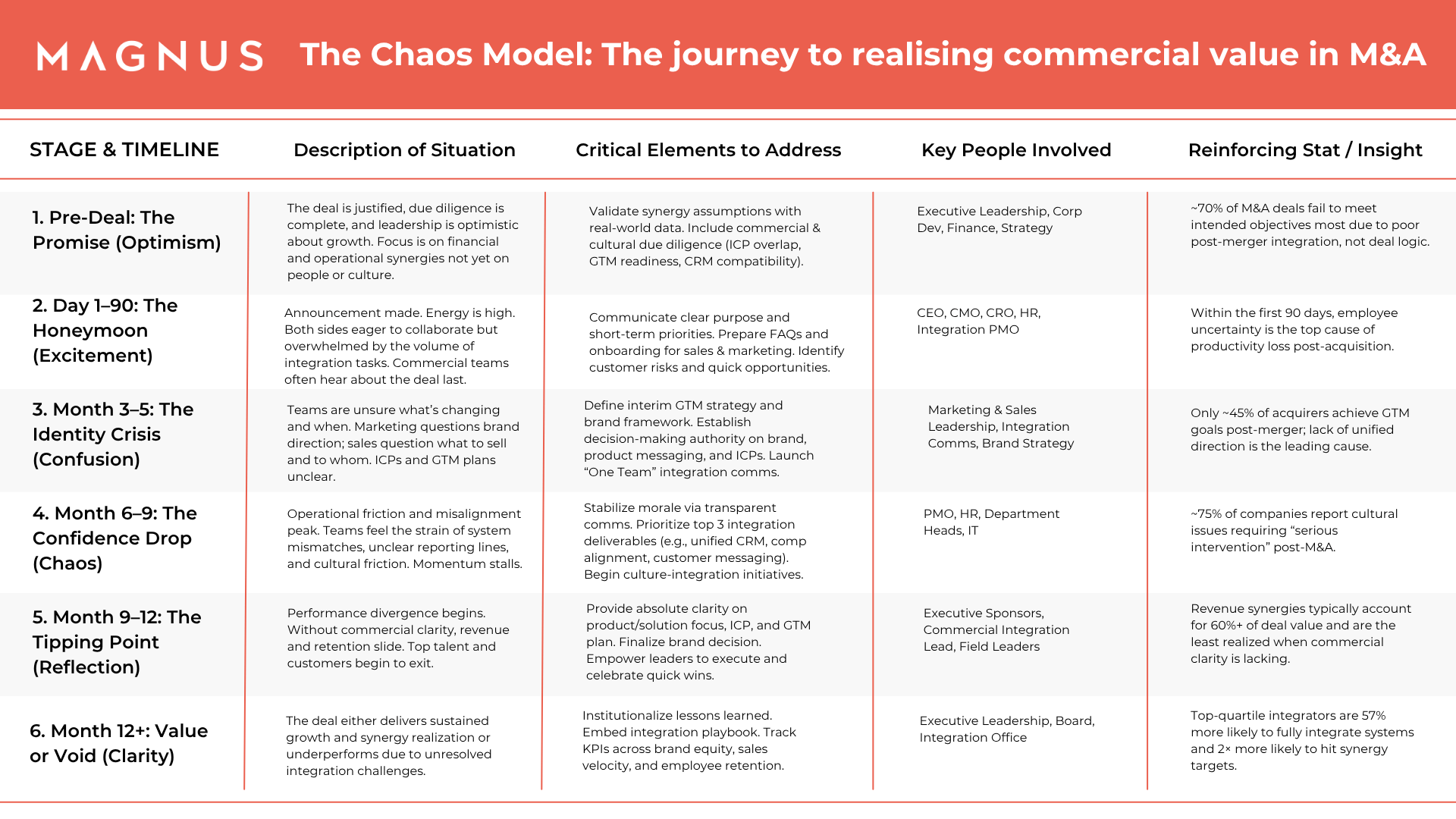
The Chaos Model and Why It Always Centres on the Commercial Core
Magnus Consulting’s M&A Chaos Model maps the predictable arc of every deal:
Optimism → Excitement → Confusion → Chaos → Reflection → Clarity.
Each stage has emotional and operational triggers, but one constant thread runs through them all: when the commercial organization; marketing, sales, and customer success lacks clarity, everything else stalls.
By the time the company hits “The Confidence Drop,” the pattern is familiarchurn ticks up, conversion rates dip below 80% of pre-deal levels, and the sales team quietly starts using the old logos again.
That’s the commercial cliff and climbing back from it takes decisive leadership intervention.
The Three Questions Every CEO Must Force Through the Chaos
1. Who is our combined ICP now?
Every deal promises cross-sell and market expansion but without redefining who the new company serves best, those synergies remain theoretical. Too often, the merged entity inherits two ICPs and tries to market to both, diluting focus and message.
Imperative: Aggregate customer data early. Map overlap. Identify the customers that drive combined revenue as well as understand new potential customers. Build your new ICP from there not from aspiration.
2. What’s our unified GTM strategy?
Integrating sales motions, marketing campaigns, and channels is where most deals lose altitude. Only 45% of acquirers hit GTM goals post-merger, and the top reason is “lack of unified direction”.
Imperative: Decide early how you’ll go to market by segment, solution, or region. Build one revenue architecture that blends the best of both sales engines. If sales doesn’t know what they’re selling by month three, your deal thesis is already in jeopardy.
3. What does this mean for our existing customers?
In B2B markets, customer trust is hard-won and easily lost. After a merger, even loyal clients wonder: “Will my account manager change? Will the product roadmap still fit our needs? Is this still the same company?”
Imperative: Treat existing customers like Day 1 prospects. Reintroduce the brand with clarity, not assumption. The message should be: we’ve expanded our value, not lost our identity.
Why the Commercial Engine Comes First
Integrating systems, and back-office functions matters but those are cost synergies. Commercial alignment is the growth multiplier.
When the revenue engine misfires, the deal burns cash instead of creating it. When it runs smoothly, it funds every other integration tech, product, operations and restores confidence across the organization.
In short: you can’t integrate your way to value if the commercial team doesn’t know what to sell, to whom, and why it matters.
Speed to Clarity = Speed to Value
Top-quartile acquirers are twice as likely to hit targets because they reach commercial clarity faster not because they have smoother IT projects or better cost control. They do three things differently:
- Prioritize GTM and ICP alignment within 90 days.
- Embed “commercial integration squads” cross-functional teams tasked with refining [DP3] customer messaging and sales enablement.
- Measure success through revenue velocity and retention, not project milestones.
Every M&A journey passes through chaos. But clarity especially commercial clarity is the difference between a deal that compounds value and one that collapses under its own weight.
At Magnus, we use the Chaos Model to help leadership teams see this journey in advance and act before value starts leaking from the commercial engine.
Because in B2B, if the revenue engine isn’t aligned, no amount of product synergy will save the deal.