Build an AI first marketing function.
Marketing AI transformation creates the opportunity to fundamentally rethink how marketing work gets done. We help marketing leaders identify where AI can create real value, test it in live workflows and redesign the operating model around what people should lead, where AI should augment and what can move into automation or marketing agents.

Redesign marketing with evidence, not assumptions.
Marketing AI transformation should start with how marketing actually works today, including the data, decisions, handoffs, knowledge and informal ways of working that teams rely on.
Automating a broken workflow simply makes the problem faster. We use real workflows and live marketing activity to establish what is ready to scale, what needs fixing first, where AI can create value now and where human judgement still matters.
That gives leaders the evidence to decide where and how the marketing function should evolve.
Build the future operating model around the work marketing needs to do, not the structure it has today.
Global payments business: from AI exploration to an evidence based operating model
Magnus mapped marketing data and real workflows, designed an initial agent architecture and tested agents against live campaign requirements across multiple lines of business. The programme created a practical route from individual AI use towards a governed, agentic marketing model built around real work and measurable value.
See how we approach AI marketing transformation →£298k
Identified in annual agency and adjacent spend
Flagged for potential internalisation, reduction or reallocation.
Design the AI first marketing operating model.
We test AI against real marketing workflows to define how the function should operate in an AI first model, based on evidence rather than theoretical use cases.
What can be automated
Repeatable work where AI can improve speed, cost or consistency with limited human intervention.
Where AI and agents can augment the team
Work where AI can research, analyse, create, coordinate or recommend while people retain judgement and accountability.
What people should continue to lead
Strategy, commercial decisions, customer understanding, creativity, stakeholder influence and other work where human judgement creates value.
How capability should be organised
What should sit within marketing teams, what can become shared capability, what should be built internally or supported by partners, and where ownership, governance and human decision rights need to sit.
Find the value first
Prove the value, then scale what works.
The quickest route to an AI first marketing function is to prove where AI can create measurable value, then scale what works. The goal is measurable improvement in marketing performance, not simply more AI adoption.
To achieve this, we identify the opportunities where AI can:
Increase commercial impact
Create greater capacity for customer insight, better decision making and more relevant activation, allowing teams to focus more effort where it can contribute to growth.
Reduce cost and manual effort
Automate repeatable production, administration and coordination, while reducing dependency on external support where capability can be owned internally.
Increase marketing capacity
Enable teams to produce, adapt, analyse and activate more without increasing resource at the same rate.
Improve speed and consistency
Reduce handoffs, reuse approved knowledge and make repeatable work faster and more consistent across teams and markets.
The emphasis is on moving quickly where the evidence is strong, and deliberately where the foundations still need work.
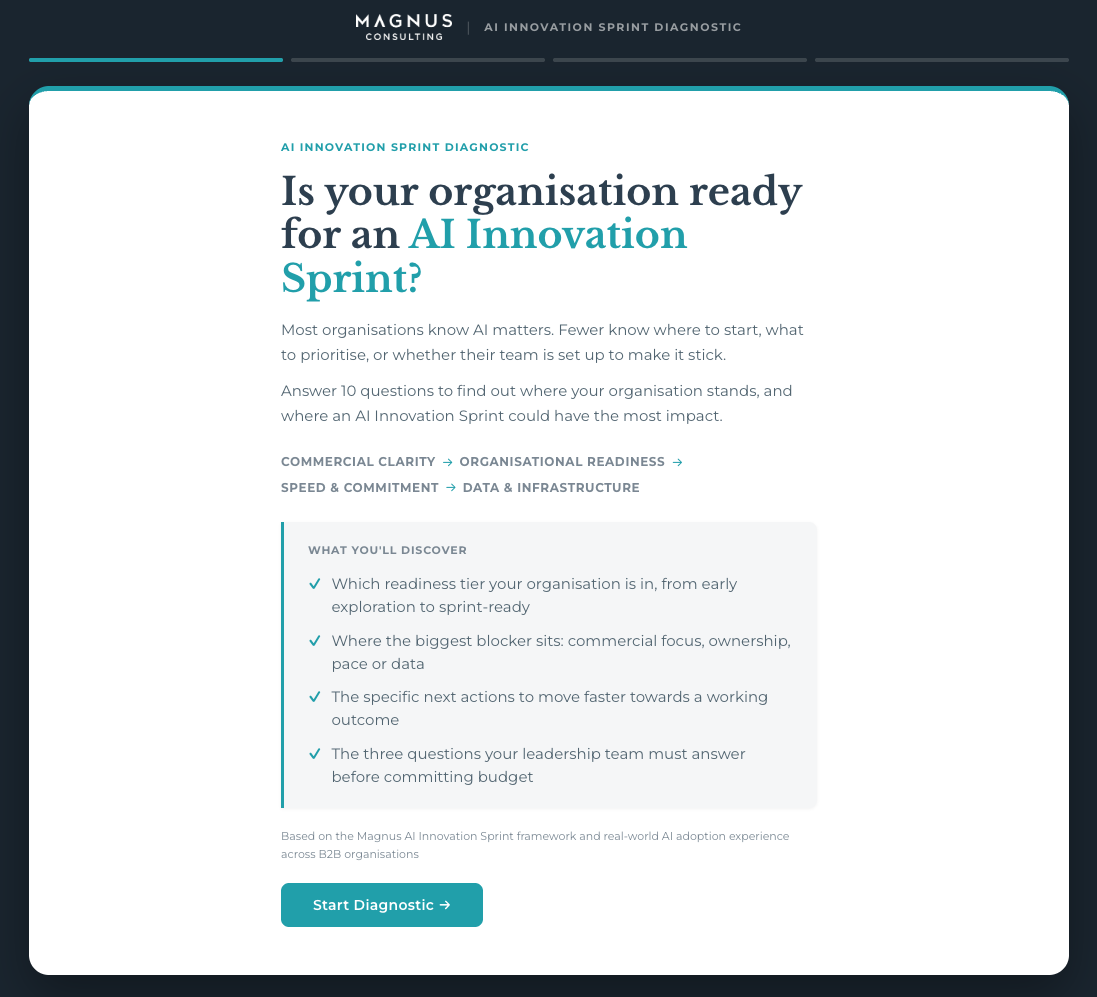
Is your organisation ready for an AI Innovation Sprint?
You've just seen where AI programmes usually stall. This diagnostic tells you exactly where your organisation stands against those same four failure points — commercial clarity, organisational readiness, pace, and data foundations.
Answer 10 questions. Get a personalised report covering your strengths, your priorities, and what organisations that move fast on AI do differently.
Results sent straight to your inbox to share with your team.