B2B AI innovation sprints. From ambition to working systems in weeks.
Most organisations don't have an AI problem. They have an execution problem. AI amplifies the processes, data and ways of working already in place. If those foundations are fragmented, AI simply scales the inefficiency.

Why Now
Four ways in which AI programmes stall.
Tools bought, data disconnected
AI licences arrive, but customer, campaign, CRM and web data remain fragmented.
Automation built on inconsistent data
Agents inherit conflicting sources, so outputs vary, trust erodes and adoption stalls.
No learning loop
One-off builds rarely improve without measurement, feedback and optimisation.
No link to commercial outcomes
Productivity gains stay anecdotal because they don't show up in pipeline, conversion or cost-to-serve.
of organisations use AI in at least one business function, yet most have not scaled it beyond pilots.
McKinsey, The State of AI 2025of companies do not effectively integrate commercial plays into revenue technology, limiting growth gains.
Bain & Company, Commercial Excellence and Revenue Growth Agenda 2025Our Approach
Three disciplines. One team.
We don't sell AI tooling. We combine commercial expertise, AI developers and behavioural change in one sprint team, focused on measurable commercial problems.
Commercial & marketing expertise
We start with the growth problem, not the technology. AI is the accelerant, not the answer.
Applied AI & automation
We design connected workflows and agents around real work, clear governance and measurable outcomes.
Behavioural change & enablement
Adoption is part of the build. Your team learns the system as it goes live.
I honestly love the platform. I've had a lot of calls in the past about different platforms, and I genuinely haven't seen anything like this before. There's always usually something missing, or still a huge manual element involved, but this feels completely different.
It's so impressive. You've thought of everything and completely changed the way businesses can use intelligence without it feeling clunky or difficult to adopt. The platform is genuinely brilliant, and you should be so proud of what you've built.
What is an AI Innovation Sprint?
An AI Innovation Sprint is a time-boxed engagement, typically three to eight weeks, focused on a defined commercial challenge.
Each sprint finishes with working agents and a way of working your team can run, govern and extend.
How the AI sprints work.
Every sprint follows the same four-phase structure. The scope changes. The shape doesn't.
Find the real problem
We identify the commercial constraint beneath the symptom and define the foundation needed to solve it.
Build the system
We structure the intelligence, workflows and AI-enabled execution layer around the priority use case.
Embed the team
Your people move from production to judgement. The system handles volume; the team owns direction and quality.
Improve every cycle
The sprint leaves behind agents that can learn, adapt and scale into recurring governance.
Behind every sprint, a six-stage improvement cycle runs on live activity — small enough to ship, structured enough to compound.
Sprints, pilots, real campaigns.
No big-bang transformations. No twelve-month roadmaps before value lands. Each cycle delivers a working simulation, measured time savings end-to-end, and a ranked backlog of improvements for the next pass.
- Map data - understand what data exists and how it's used today.
- Infer process - reveal how work actually flows across campaigns.
- Test live - validate the model against live activity.
- Update agents - design automation aligned to real workflows.
- Simulate - run end-to-end execution before scaling.
- Hypotheses - focus on changes that drive speed and quality.
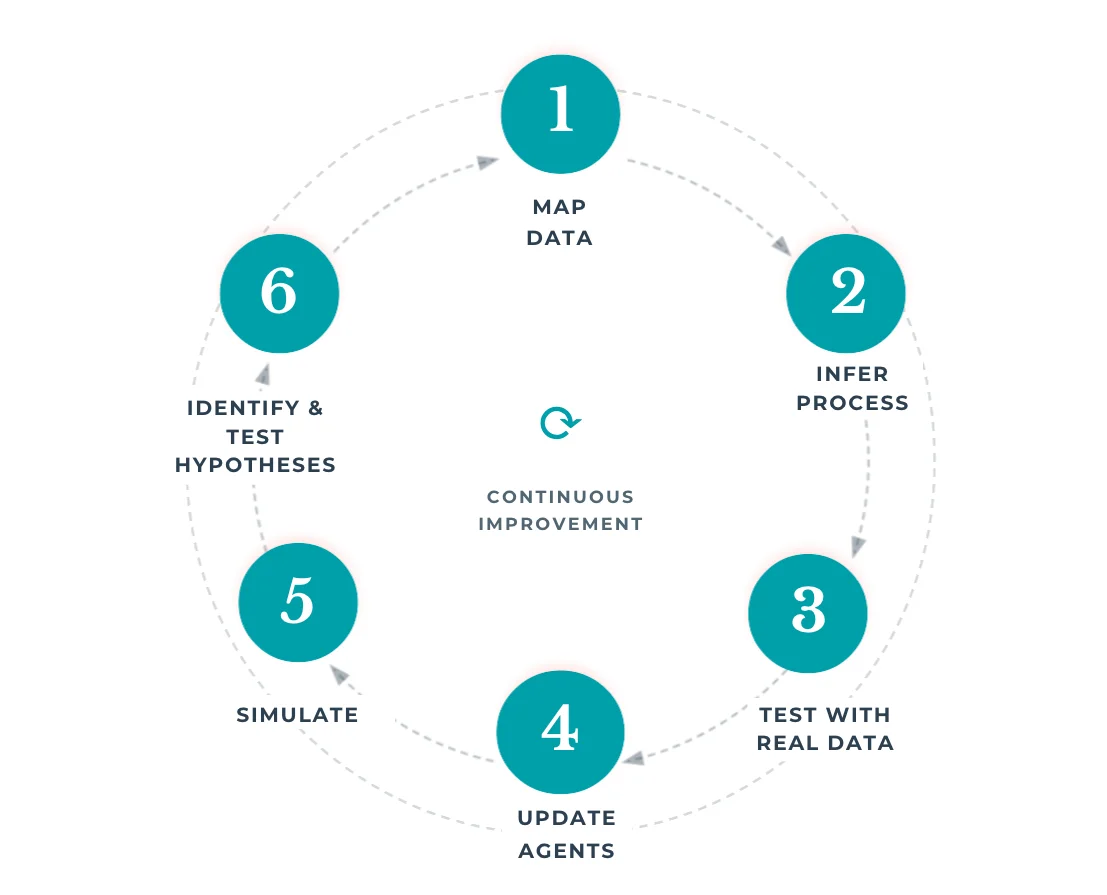
Map data as it actually exists. Test in live environments.
Improve what works. Scale what delivers.
What AI Innovation Sprints look like
Four engagements. The same sprint shape. Different commercial problems. Each one left the team working differently.
A global consultancy's content wasn't landing across markets. The stated problem was capacity. The real problem was architecture: personas didn't account for geography, sector, and role simultaneously.
Magnus built a multi-dimensional persona framework from first-party research, then deployed AI to generate five content formats across six markets and six personas in parallel. Delivery accelerated from months to weeks. AI-generated content outperformed human-only content on engagement.
Markets covered with persona-driven content
Content sprintPersona combinations across geography, sector, and role
Multi-dimensional frameworkA 10,000-respondent workplace survey was locked in static reports that took months to process. The board wanted to demonstrate genuine AI capability, not a vanity project.
Magnus designed a three-sprint delivery: proof of concept in five days, production build in thirty, global launch in fifty-five. The result was an AI-powered research tool deployed across ten markets, with 400+ automated quality tests preventing hallucination. Sales teams adopted it as a conversation-opener for client engagements.
Days from kick-off to global launch across ten markets
Three-sprint deliveryAutomated quality tests preventing AI hallucination
Research intelligence platformA €5 billion professional services firm asked whether their brand was consistent across markets. The real question was whether it was relevant to their buyers.
Magnus combined AI-powered scoring with qualitative persona analysis across 125 page-persona combinations and 25 URL properties. The audit revealed the transformation required was five to ten times larger than anticipated, and shifted the entire organisation from thinking inside-out to outside-in.
Page-persona combinations scored for relevance
Brand audit sprintURL properties audited across the brand estate
€5bn professional services firmA major consultancy was competing for specialist talent with a post-and-pray approach. Every role got the same generic treatment regardless of geography, seniority, or specialism.
Magnus built a composable persona system across four dimensions, geography, function, specialism, and seniority, then deployed AI to generate personalised job ads at scale. What previously took weeks of copywriting now takes minutes. The platform handles hundreds of role combinations and reframes every vacancy as a candidate value proposition.
Dimensions in the composable persona system: geography, function, specialism, seniority
Recruitment sprintFrom kick-off to live self-service platform
Major consultancyA working system in weeks, owned by your team from day one.
- Commercial problems solved in weeks, not quarters.
- AI embedded directly into your GTM motion.
- Clear sprint milestones and deliverables.
- Senior commercial thinking and Magnitude execution in one engagement.
- Full handover so your team can run and scale the system independently.

Surface, Don't Decide
AI is infrastructure, not leadership. It handles volume, pattern detection, synthesis, and consistency. People handle strategy, prioritisation, trust, and judgement. Every system we build respects that line.
What AI handles
- Activating research and market intelligence at speed
- Generating and localising content across markets and segments
- Scoring brand consistency across hundreds of combinations
- Monitoring performance signals continuously
- Producing first drafts at scale for human refinement
What people own
- Strategic direction and commercial priorities
- Positioning, messaging, and brand voice
- Buyer insight and relationship judgement
- Quality governance and editorial decisions
- Stakeholder alignment and organisational change
The shift that matters: In every sprint we've delivered, the team's role shifts: from production to judgement. Content writers become editorial directors. Analysts become strategists. AI handles the volume. Your people handle the direction. That's the change that sticks.