From Chaos to Clarity, at Pace.
Post-acquisition, commercial leaders rarely struggle with ambition. They struggle with knowing where to focus and how to turn opportunity into wins. Every deal moves through the same arc, from optimism to chaos, and the leadership teams who reach clarity first are the ones who realise the value.

Three areas of focus. The path from chaos to clarity.
One Ideal Customer Profile, Not Two
Most acquisitions inherit two customer definitions, diluting investment and message across audiences the deal has already made obsolete.
Magnus builds one evidence-based ICP from combined data, sharpening focus and turning theoretical synergies into an executable growth plan.
One Go-To-Market Engine, Not Two
Sales, marketing and customer teams keep operating through different propositions and forecasting methods, so no one trusts the pipeline number.
Magnus designs one commercial operating model that unifies both engines, improves forecasting and accelerates execution.
Customer Trust, Protected Not Risked
Existing customers quietly question whether the relationship, service and value they receive is about to change, and churn follows if nothing reassures them.
Magnus reintroduces the brand with clarity, building the confidence that underpins retention and growth.
Is your commercial engine ready to realise the deal?
Most leadership teams know the deal thesis. Fewer have the alignment to convert it into revenue. This assessment shows where you stand, and where the gaps are.
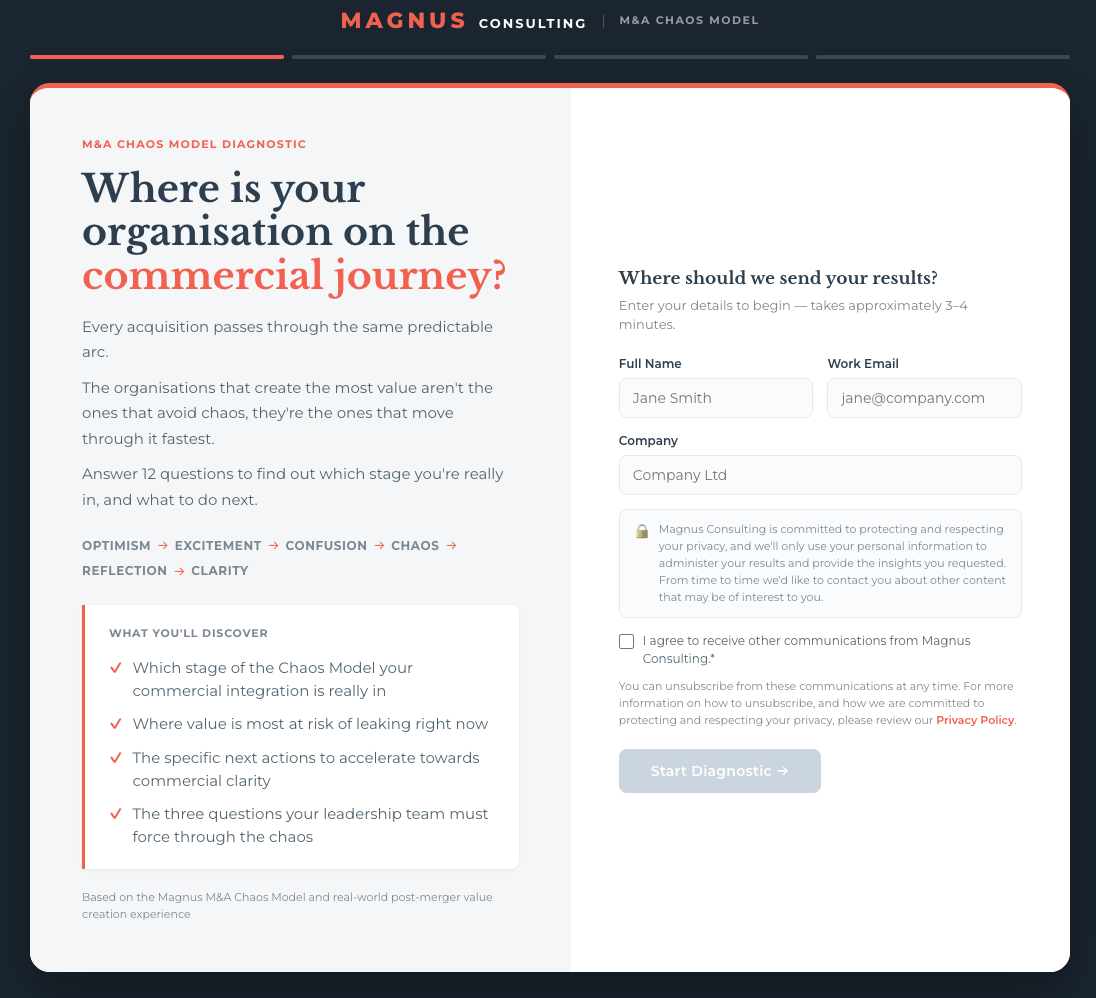
Answer 12 questions. Get a personalised readiness report covering your strengths, your priorities, and which stage of the Chaos Model your organisation is really in.
Results sent straight to your inbox to share with your leadership team.
- Takes 2 minutes
- No commitment required
The same acquisition, four different conversations
Marketing, sales and growth leaders all describe the same problem from different perspectives. Here's how each executive experiences the months after the deal, where they agree, where friction builds, and where commercial value quietly leaks.
"The board approved this deal on a growth story. Six months in, integration is on track, but the numbers that justified the price still aren't showing up. I need to know we're building one business, not running two."
What they're worried about
- Synergy targets were set with no clear commercial owner
- Operational integration looks healthy while revenue synergies slip
- Investor and board confidence erodes each quarter value is delayed
What success looks like
- Commercial value realised alongside operational integration
- A forecast the board can actually trust
- A credible, evidence-led exit story
Actions they're taking
- Making commercial integration a board-level priority
- Holding focus on customer, proposition and growth throughout
- Establishing a clear decision-making cadence across the C-suite
"I'm forecasting off two pipelines that don't reconcile, with sellers reverting to the logos they know. Until we have one revenue architecture, every number I take to the board is a best guess."
What they're worried about
- Two forecasting methodologies that won't reconcile into one truth
- Conversion dipping below pre-deal levels as sellers hesitate
- Cross-sell and new-market synergies that stay theoretical
What success looks like
- A unified engine with one pipeline and one forecast
- Stronger conversion and consistent revenue performance
- Quarter-by-quarter momentum that holds up to sponsor scrutiny
Actions they're taking
- Building one revenue architecture across both organisations
- Standardising pipeline definitions and forecasting discipline
- Aligning sales motion and go-to-market approach as one
"We're marketing to two ideal customers at once, so our message lands for neither. Meanwhile loyal customers are quietly asking whether they're still buying from the company they chose."
What they're worried about
- Two ICPs and two propositions diluting focus and spend
- Customer trust weakening exactly when cross-sell should build
- Sellers defaulting to legacy messaging over the new value story
What success looks like
- A clear market position and one consistent message
- Demand generation aligned around the combined ICP
- Stronger customer engagement and retention through change
Actions they're taking
- Consolidating propositions into one combined value story
- Reintroducing the brand to existing customers with clarity
- Aligning campaigns and enablement to the new ICP
"Everyone owns a piece of growth, which means nobody owns the whole. The data is fragmented, the systems don't talk, and our AI ambitions are running on inconsistent foundations."
What they're worried about
- Fragmented data and disconnected systems limiting visibility
- Commercial integration that is everyone's job but no one's priority
- AI and automation amplifying inconsistency rather than removing it
What success looks like
- One connected commercial operating model
- Reliable data and consistent, scalable execution
- Cross-functional teams working to one growth agenda
Actions they're taking
- Aligning commercial systems and the customer lifecycle
- Establishing clear ownership of commercial integration
- Embedding scalable, repeatable ways of working
From five businesses to one brand
atombit had assembled five complex AI, data and analytics businesses through acquisition, but the commercial value of those acquisitions had yet to be fully realised because the organisation wasn't yet operating as one business. Employees described the business in different ways, customers still engaged with the individual businesses, and there was no clear answer to "What does atombit do?"
Magnus combined leadership interviews, AI-enhanced customer research, competitor analysis and collaborative workshops to define a new market category and a differentiated commercial story, then embedded it into an AI-powered Brand Strategy Skill so every employee could answer that question consistently.
- Five complex businesses united behind one shared vision and commercial story
- One market category defined from leadership interviews, customer research and competitor analysis
- AI-powered Brand Strategy Skill embedded into daily workflows for consistent, on-brand content

Understand why value leaks, and how leaders regain clarity

The Missing Link in M&A Value Creation: Commercial Clarity
Why commercial clarity, not integration, decides whether an acquisition realises the value it was designed to create.


Integrated, but Not Aligned: Why M&A Integration and Value Creation Are Not the Same Thing
Integration consolidates systems and cost synergies. It doesn't decide what the combined company sells, to whom, or why, and that gap is what stalls deal value.

Uniting the business behind one brand after £500m of acquisitions, with a three-year effectiveness roadmap and stronger alignment between sales and marketing.
Read the growth story →Every post-acquisition challenge starts with knowing where value is leaking
Speed to commercial clarity determines speed to value creation. Let's find where your combined commercial engine is losing momentum, and what it takes to realise the deal thesis.